I have always thought of myself as a light traveller. Five months in Ukraine put an end to that idea. We were packing for an unknown number of situations, stocking a base we’d need to run for months, and working within luggage limits that had nothing to do with how much we actually needed to bring. I packed and repacked those suitcases more times than I want to admit and unfortunately had to leave behind a lot of what I really wanted to bring.
We’d normally cross by train, as we’ve done before, and the thought of wrestling three heavy suitcases and two backpacks across two trains and a border crossing wasn’t appealing. Our NGO partner offered a better option. Volunteers in Poland repair donated cars and send them across into Ukraine, and we were able to drive across one of those vehicles, which meant our luggage rode in the boot instead of on our backs. We met the two women who coordinate this work, and the mechanic who handed over the keys — a Ukrainian veteran who had been injured in combat and now spends his time fixing vehicles for his brothers in arms, who constantly need replacement cars because Russia specifically targets the vehicles used to evacuate the wounded. This particular car was headed to the Azov Battalion. It will likely go on to save lives the same way so many others already have.
The car was registered as humanitarian aid, so at the border I had the paperwork to queue at the customs office on the Ukrainian side. The line was full of truck drivers who looked like they’d been waiting for hours. When they saw me and realised I was there for humanitarian aid, they waved me straight to the front and kept checking with the clerk to see if she was ready for me. It was a small kindness, and it stayed with me. Crossing into Ukraine and seeing that sign again — the fifth time now — is still hard to put the emotions into words. We’re just so glad to be here, to be able to help even a little. For me there’s also something that feels like coming home.
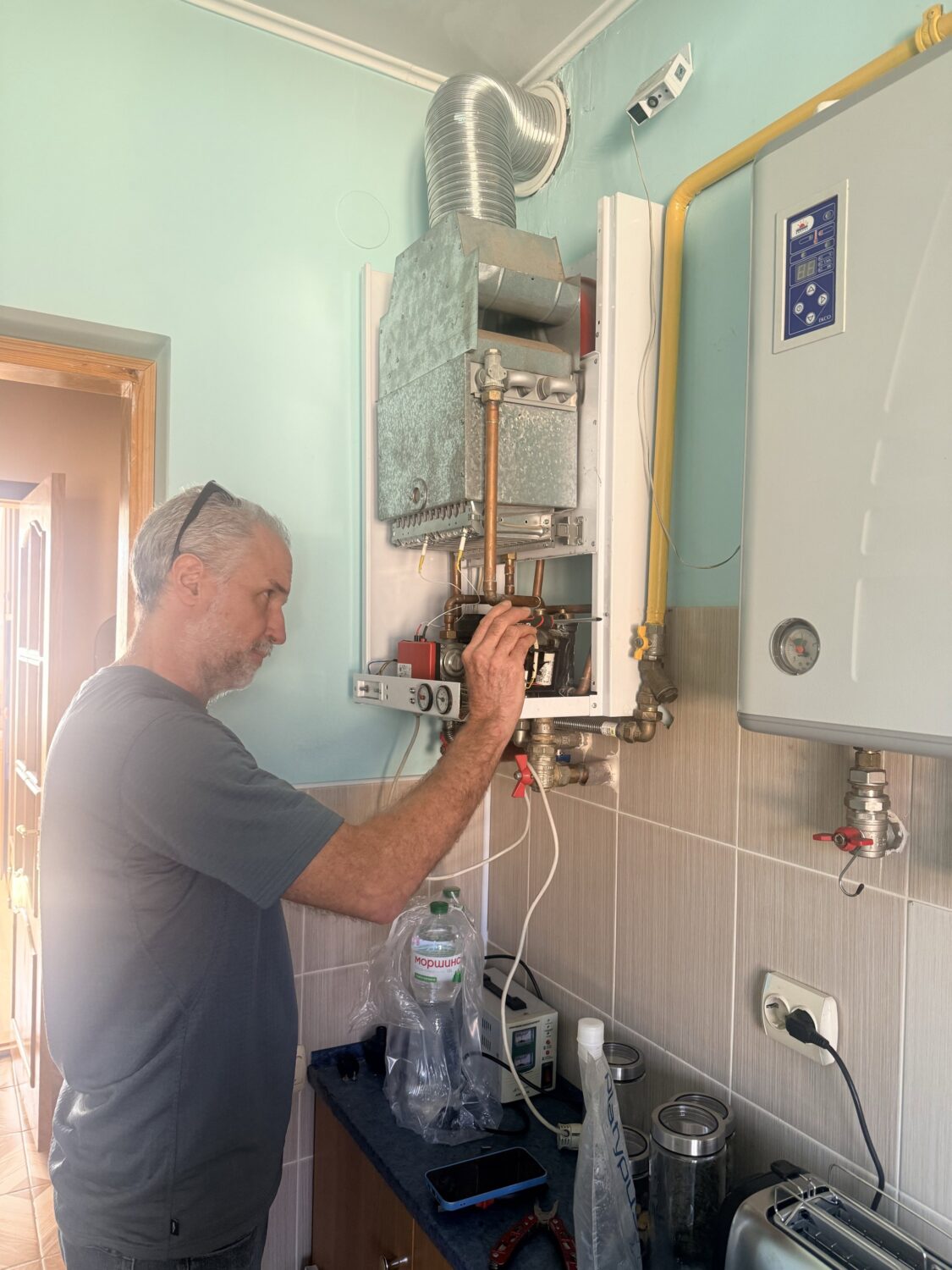
We arrived in the middle of a record-breaking heatwave, and between that and jet lag we could barely move for the first few days. Since then there’s been a lot to do getting the house set up to actually function as a base for the months ahead. We’ve had two power outages and some water issues — the town’s central water supply relies on electricity, so when the power goes, so does the water. We do have a fair amount of backup here; we just need to work out how it all fits together. There’s also a garden, which I’m always glad about wherever I end up — growing food is a real part of resilience here, not a hobby. The previous owners have let it go a little as they prepare to move house, but there are still plenty of tomatoes in the greenhouse, along with peppers, cucumbers, and berries, although the heatwave has hit them hard.
There’s been a fair amount of bureaucracy that comes with staying for longer than a short visit. We needed notarised translations of our passports. I already had a tax number, but Ron needed one, so we went to the state tax office and sat for a couple of hours watching our ticket number keep sliding to the bottom of the queue. Right at closing time, with everyone else seen, the screen went blank and staff started leaving. We went up to the window anyway. The woman there spoke no English, called a supervisor, and then left too. Eventually the supervisor explained, through Google Translate, that the working day had ended. We must have looked as unimpressed as we felt, because she relented, sighted our documents, processed the form, and asked us to come back the next day — when Ron was handed his tax number well ahead of the usual wait. Opening a bank account, by contrast, was simple, and the woman who helped us was lovely. The residency application was the real challenge: despite the long list of documents we’d been told we needed, it turned out we also needed the original — not a copy — of CMA Ukraine’s charity registration certificate, a new requirement CMA themselves hadn’t been told about, because their website hadn’t been updated yet. We also learned we needed health insurance covering thirteen months, not the twelve months our residency permit actually covers. And to our surprise the office that covers issues for foreigners had not one person who spoke English.
Lviv is relatively safe compared to other areas of Ukraine.
Kyiv has had no quiet days this week. Air raid alerts have sounded almost daily, mostly for Shahed drones, but at least twice for missile attacks. As one Ukraine news summary put it this week: residents joke darkly that they miss “the foreplay of drones” — the old, longer warning before an attack — because at least it gave you time to get to a shelter. Now it’s fast: you survive fast, or you don’t. That’s the gallows humour keeping people upright. It didn’t keep everyone upright this week. A family house near Brovary was hit overnight, killing a grandmother, grandfather, and their three-year-old grandson. A railway station nearby was struck as workers waited for a delayed train home — eight people were killed on the platform. A twenty-year-old volunteer, Vitalina Yarovenko, died in a double-tap strike while helping people injured in an earlier hit, a tactic specifically designed to kill those who come to help. Oleksiy Yukov, who had spent his life recovering and repatriating the bodies of the fallen, was fatally wounded doing that same work. And many, many more. July turned out to be the deadliest month for civilians since the war began.
Our partner organisation is in a busy stretch, deep in planning for upcoming mobile clinics, surgical missions and team retreats. Staff are tired — it’s hard work raising funds and running programs with very few resources, and we hope to be genuinely useful while we’re here. We’re still working out what the house needs to properly function as a place of support, since the previous owner hasn’t left as much behind as he’d indicated he would. Planning is also underway for a retreat that will be a time of healing and rest for those who spend their lives caring for others — thank you to everyone who has donated specifically toward that.
We had a lovely, brief visit from Jaan, a dear friend from Estonia who we first met years ago as a volunteer doing youth work with us in Kowanyama, and who is now a pastor there. He and a friend raised funds to drive donated equipment to us in Lviv, purely to encourage us — some much-needed gear for our office and training room, plus some medical equipment and supplies and a few Estonian treats for us. It was wonderful to see him again after all these years, though the visit was short; they had to turn straight around to get back to work.
Ron has also gone back to the particular sport of driving in Ukraine. CMA Ukraine has kindly been lending us whatever car they have spare while we sort out our own situation, and we’re very grateful for it — though it does mean Ron navigating a donated right-hand-drive car from the UK on Ukrainian roads.
We also made it to the biggest farmers market in western Ukraine — acres of wholesale stalls and trucks stacked with fresh fruit, vegetables, and mushrooms. It took real effort not to buy far more than we needed. People here buy in bulk to preserve, something that runs in my blood from both my German and Ukrainian sides, and it’s an important part of Ukrainian resilience — you can buy preserving jars in bulk almost anywhere. In the early days of the full-scale invasion, many Ukrainians survived being trapped in basements for months on food they’d preserved and stored. I’ve genuinely never seen so many enormous tomatoes in my life. I got to practise a little of my Ukrainian while I was at it. The watermelons are in season, and there were truck-sized loads of the biggest watermelons I’ve ever seen, along with rockmelons roughly five times the size of anything you’d find in Australia. My grandad used to describe fruit like that, and I always assumed it was a homesick man’s exaggeration of memory. It wasn’t.
Now it’s back to the work of setting this home up to be resilient through the war and the coming winter, and to be a haven that can genuinely help people here — through training, through support, and through everything else this mission will need over the next five months. As well as planning and preparing for the work ahead. This is the first update in what will be a long series. Thank you for reading, and for being part of it.
If you’d like to help fund the team retreat, the mobile clinics, or simply keep this work going, you can find out exactly what your support buys on the ground at passingthrough.net/donating or through our 200 Heroes for Ukraine campaign. No pressure at all — just an open door if you’re curious.
Want the next update straight to your inbox? Subscribe here.