I’ve been watching all the footage coming out of Ukraine this week, and I keep coming back to the same thought: this isn’t about winning ground anymore. It’s about wearing people down.
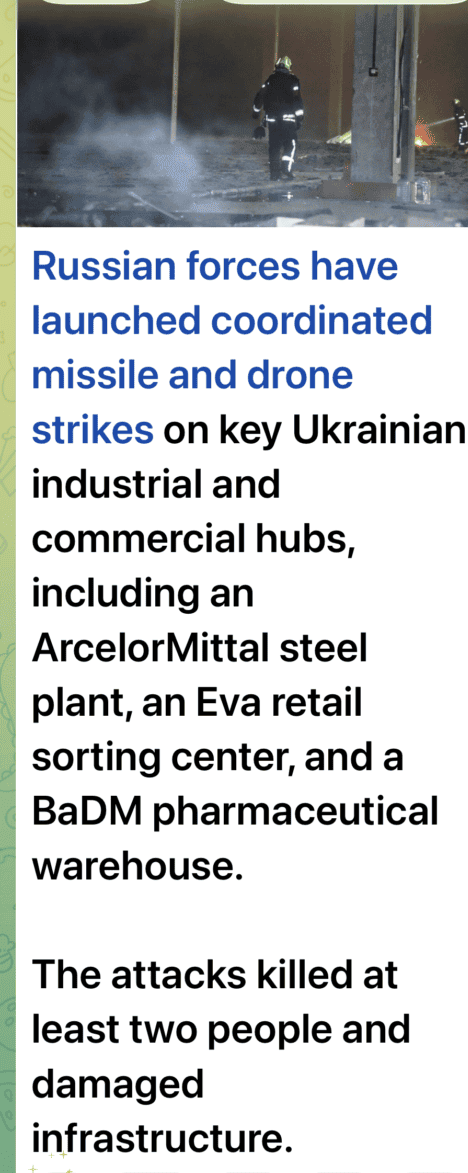
Over the past few weeks, Russia has been systematically hitting the places that keep ordinary Ukrainian life running. Not army bases. Not ammunition depots. Supermarkets. Food distribution warehouses. A toy company. A power plant that heats people’s homes. If you needed proof that this war has a second front — one aimed squarely at civilians and what they eat, what they buy, how they stay warm — the last few weeks have provided it.
Food and household goods
On the night of August 4–5, Russian strikes destroyed the logistics centre of Novus, two distribution centres belonging to Fozzy Group (the company behind Silpo, one of Ukraine’s biggest supermarket chains), a Nova Post sorting hub, and a huge warehouse complex belonging to Rozetka. Rozetka said the damage couldn’t be repaired — somewhere around $81 million gone, along with whatever those warehouses were holding.
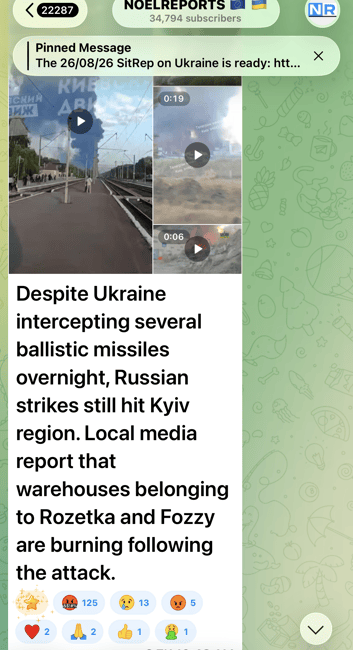
Then on August 27, it happened again, only worse. Kyiv had ten separate air raid alerts that day. Warehouses belonging to Varus, Fora, and KOLO — all supermarket chains — were hit in the Kyiv region, along with Roshen (yes, the chocolate company), Comfy, and a children’s toy distributor. Rozetka and Fozzy warehouses were burning again, this time in Boryspil.

Read that list again. Groceries. A toy store. Chocolate. These are not military targets by any definition. They’re the supply chains people rely on to eat dinner and buy their kids a birthday present. When you hit them again and again, on purpose, you’re not degrading an army — you’re trying to make daily life miserable enough that people stop believing it can get better.
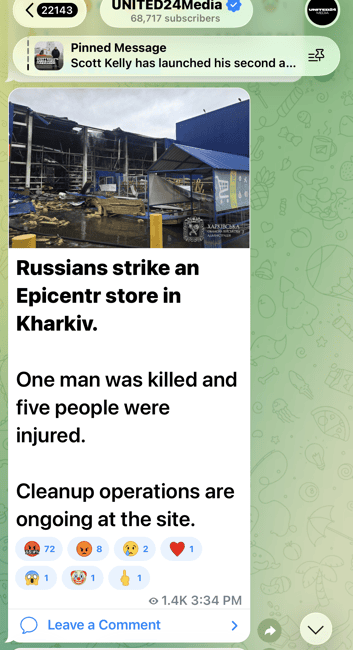
In Kharkiv, a drone struck the city’s last remaining Epicentr hypermarket — the one home-improvement store that had somehow stayed open through everything else. One man was killed. At least four more were injured. It had survived this long, and then it hadn’t.
And then there’s Kherson, where four guided bombs hit the city’s heat and power plant in one go. That plant heats people’s homes. It has never had anything to do with the front line. It’s just easier to break than it is to defend, and winter is coming.

And it hasn’t stopped since. Warehouses belonging to Eco-Market, another Ukrainian grocery chain, caught fire in the Kyiv region in a more recent strike. And in Kharkiv, Russia hit an Epicentr store again — the second attack on a shopping centre in that city. Not the first time. The second.


Even the UN is adapting to it
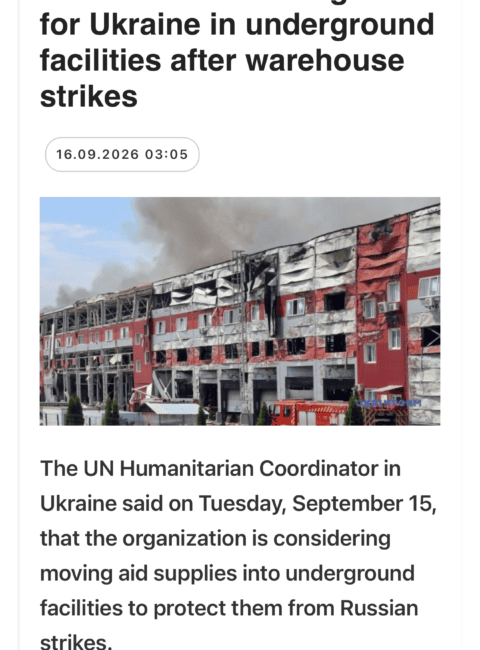
This week, the UN’s own Humanitarian Coordinator in Ukraine said the organisation is now considering moving its aid supplies into underground facilities, specifically to protect them from Russian strikes on warehouses. Read that twice. The UN is planning around the assumption that its own humanitarian stockpiles could be targeted next. ( and why not? WHO medical humanitarian warehouses have been hit several times in last few weeks)
That’s not a small thing. That’s an international body looking at the pattern of the last several weeks and concluding the only safe place left for food and supplies is below ground. It tells you everything about how deliberate and sustained this has become.
Why I don’t think this is an accident
I try not to throw around words like “deliberate” carelessly. But it’s hard to look at food warehouses, supermarket chains, and a heating plant all hit within the same few weeks and call it coincidence. An economist I read this week, Oleksandra Betliy, said it plainly: Russia is using drones and missiles to hurt Ukraine’s economy and wear down the population psychologically, hoping exhaustion pushes people toward peace on Russia’s terms. That’s not a guess. That’s the strategy, stated out loud.
What strikes me most is how ordinary the targets are. War usually feels distant when it’s tanks and front lines. It feels very close when it’s the grocery store you’d have shopped at, or the toy shop, or the heat in your building. That’s the point, I think — to make the war impossible to ignore even for a single day, in the smallest, most domestic ways. Take away the food, and you don’t need to take much else.
And still, people rebuild. Stores reopen. Deliveries get rerouted. Winter gets faced anyway. That refusal to just stop is its own kind of quiet defiance, and I don’t think it gets nearly enough credit.
If you’re looking for something you can do…
- Donate to OPT Ukraine at passingthrough.net/donating — funds go toward the humanitarian response.
- Share this with someone who still thinks this war is only being fought at the front line.
- Keep reading. The Kyiv Independent and Kyiv Post are covering this closely, and it’s worth following.
- Consider committing to standing with Ukraine as one of our heroes – it only takes the cost of a coffee per week. Sign up HERE.
We can’t rebuild the warehouses. But we can make sure the people who are trying to aren’t doing it alone.
Sources referenced: Kyiv Times, NOELREPORTS, Радар ракет (Rocket Radar), Україна Новини, UNITED24Media, Kyiv Post, Times of Ukraine, Kyiv Independent, and Ukrinform (via Reuters), reporting between August 4 and September 16, 2026.